
Are Smart Thermostats Worth It? 8 Things to Know Before You Buy
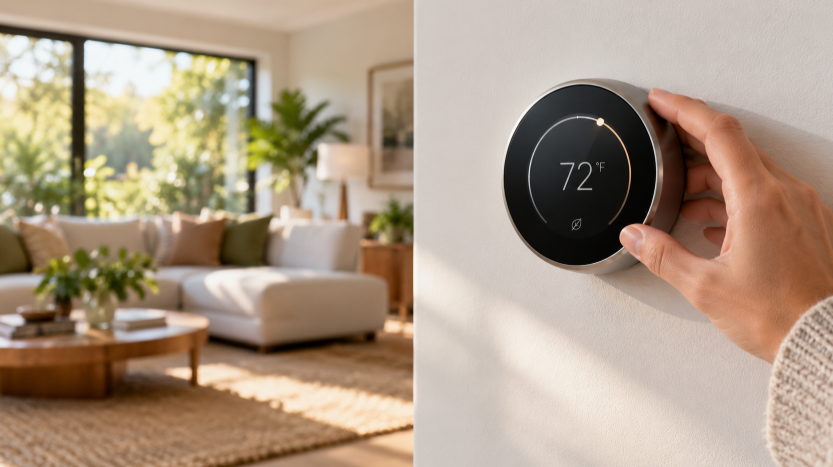
Smart thermostats are sold as an easy way to cut your bills. The truth is more nuanced: they can help, but how much depends on your home, your climate and how you live. Here are 8 things to know before you spend money on one.
1. The average savings are real, but modest
ENERGY STAR says certified smart thermostats save approximately 8% of heating and cooling bills, or about $50 per year. That figure is based on data from real homes across the U.S., not lab tests, and it can be higher depending on climate, comfort preferences, who is home and what HVAC equipment you have.
Notice what that percentage applies to: heating and cooling only, not your whole electric or gas bill. If your heating and cooling cost $1,200 a year, 8% is about $96. A ConsumerAffairs review published in October 2026 uses that same kind of example.
Quick take: Expect a modest, steady saving, not a dramatic drop in your bill.
2. Your climate and habits decide your results
ENERGY STAR notes that homes with big swings in yearly temperature generally save more, while temperate climates usually save less because heating and cooling bills are lower to begin with. Homes that are occupied all day also see smaller savings, since there are fewer empty hours to cut back.
Habits matter too. The ConsumerAffairs review says households that leave the heat or air conditioning running at full blast while nobody is home stand to gain the most. Households that already follow an efficient schedule gain the least.
There is also a note of caution. The same review mentions an academic working paper, revised in November 2024, that found little evidence of a significant average drop in energy use across the homes it studied. Those results apply to the technology and households in two field experiments, not to every thermostat.
Quick take: A smart thermostat pays off most if your house is often empty and your climate is extreme.
3. A basic programmable thermostat can save money too
You don't need a smart device to get the biggest benefit, which is turning the temperature back while you're asleep or away. The U.S. Department of Energy estimates that turning your thermostat back 7 to 10 degrees for 8 hours a day can save up to 10% a year on heating and cooling. A basic programmable thermostat can do that.
The catch is the word "programmable." ENERGY STAR points out that programmable thermostats stay on their schedule until someone changes it, and homeowners often don't program them well. Smart models learn your routine or use sensors to adjust automatically, so they work even if you never touch a schedule.
Quick take: If you will actually set and update a schedule, a cheaper programmable model may be enough. If you won't, a smart one earns its price.
4. Check your wiring before you buy
Not every thermostat works with every heating or cooling system. Manufacturers such as Wyze say their models fit 24-volt low-voltage systems, including most forced-air gas, oil and electric furnaces, and 24-volt heat pumps.
These setups are usually not compatible:
- Electric baseboard heaters
- Thick 110/120V wires joined with wire nuts
- Equipment labeled 120/240V, or terminals marked only L1 and L2
- Zoning panels and modulating equipment
Some models also need an extra wire to the thermostat, often called a C-wire. Don't guess: use the maker's online compatibility checker before you order. The same Wyze page says its checker takes about three minutes.
Quick take: Five minutes of checking can save you a return and a headache.
5. Heat pumps need extra care
If you heat with a heat pump, a big overnight temperature drop can backfire. The ConsumerAffairs review warns that large winter setbacks can trigger costly backup electric resistance heat, which uses far more electricity than the heat pump itself. Thermostats designed for heat pumps with adaptive recovery can reduce this problem.
ENERGY STAR adds that homes with variable-capacity heat pumps or air conditioners generally do best with the thermostat the manufacturer recommends, whether or not it is ENERGY STAR certified.
Quick take: With a heat pump, choose a compatible model and keep temperature changes small.
6. Know the price and how long it takes to pay off
The Citizens Utility Board says retail prices run about $100 to $250 (fact sheet updated March 2025). Many utilities offer rebates. For example, the same fact sheet lists $75 from ComEd and $100 from Ameren for customers in Illinois. Rebates vary by utility and location, so check yours before you buy.
To estimate payback, divide what you pay (after any rebate and installation) by your expected yearly savings. The table below uses ENERGY STAR's $50 average and the $96 example from page 1.
| Cost after rebate | Payback at $50/year | Payback at $96/year |
|---|---|---|
| $100 | 2.0 years | 1.0 years |
| $200 | 4.0 years | 2.1 years |
| $250 | 5.0 years | 2.6 years |
These are estimates, not guarantees. Your own heating and cooling costs set the real number.
Quick take: A rebate and a high heating and cooling bill make the math much friendlier.
7. Look for the features that actually matter
Marketing lists are long. These are the points that tend to matter most:
- ENERGY STAR certification. The Citizens Utility Board recommends choosing a certified model. ENERGY STAR also requires certified smart thermostats to be able to work with utility demand response programs.
- Automatic adjustment. Smart thermostats can learn your preferences or react to whether someone is home and to indoor and outdoor temperature.
- Wi-Fi. Your home needs Wi-Fi to use app control.
- Geofencing is optional. ENERGY STAR doesn't require it, so check whether a model offers it if you want your phone's location to trigger changes.
- Privacy settings. Customer data stays with the service provider, so read what the app collects.
Quick take: Prioritize compatibility and certification over a long feature list.
8. Get the most out of it once it's installed
- Use setbacks, but keep them reasonable. The DOE guidance of 7 to 10 degrees for 8 hours a day is a good reference for heating and cooling when you're away or asleep.
- Check the schedule after the first few weeks. If you keep overriding it, adjust the settings so the thermostat matches how you live.
- Fix the house too. The EPA says air sealing plus attic and crawl space insulation saves about 15% on heating and cooling on average, as a package of improvements. A thermostat can't make up for a leaky house.
- Keep an eye on your bill. Compare kWh or therms to the same month last year, not just dollars.
So, is a smart thermostat worth it?
It's likely worth it if you often leave the house empty, you live where winters or summers are harsh, you won't maintain a schedule, and you can get a rebate. You may want to skip it if you are home most of the day, your climate is mild, you already follow an efficient schedule, or your system isn't compatible.
Want to find out where else your energy is going? Read why your electric bill might be so high all of a sudden and our guide to lowering your electricity bill with 9 practical steps.
This article is general information. Savings vary by home, climate, equipment and utility. Ask a licensed HVAC technician if you're unsure about wiring or compatibility.
Leave a Reply